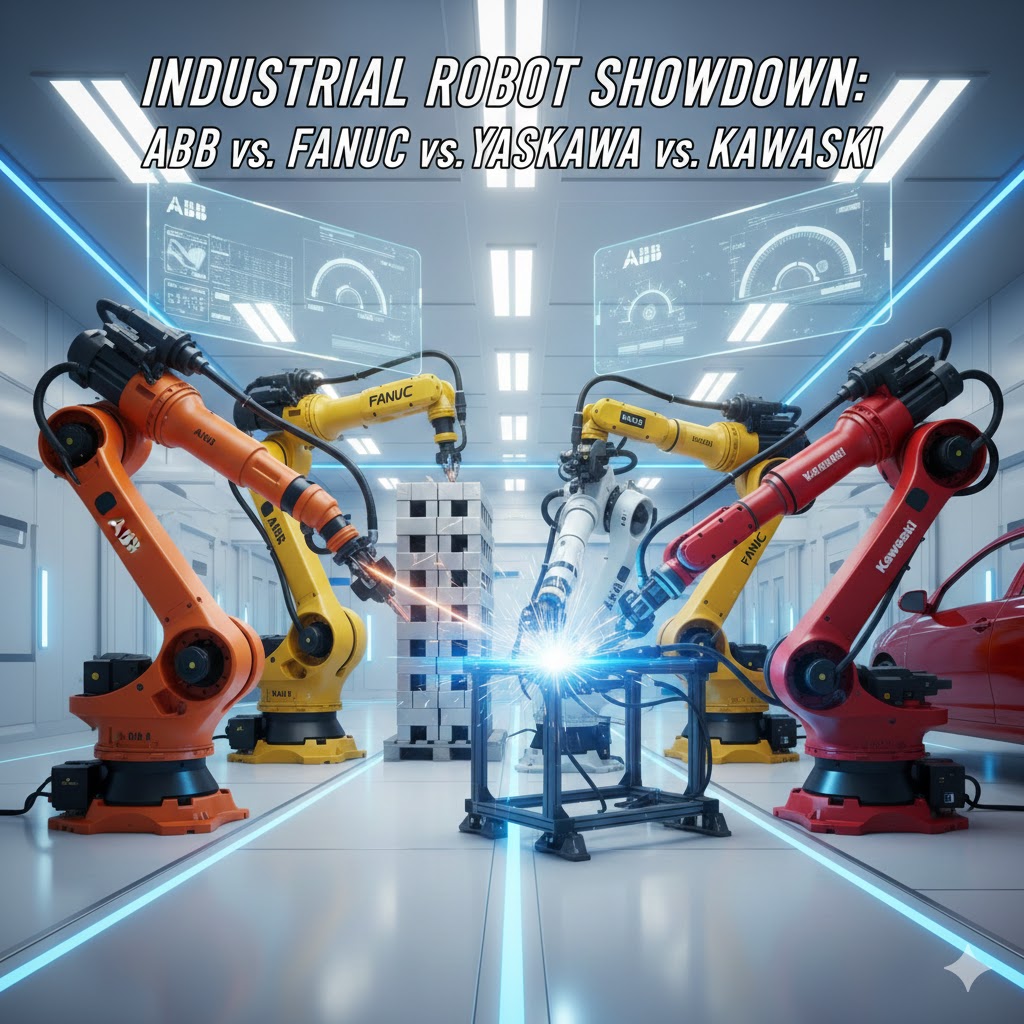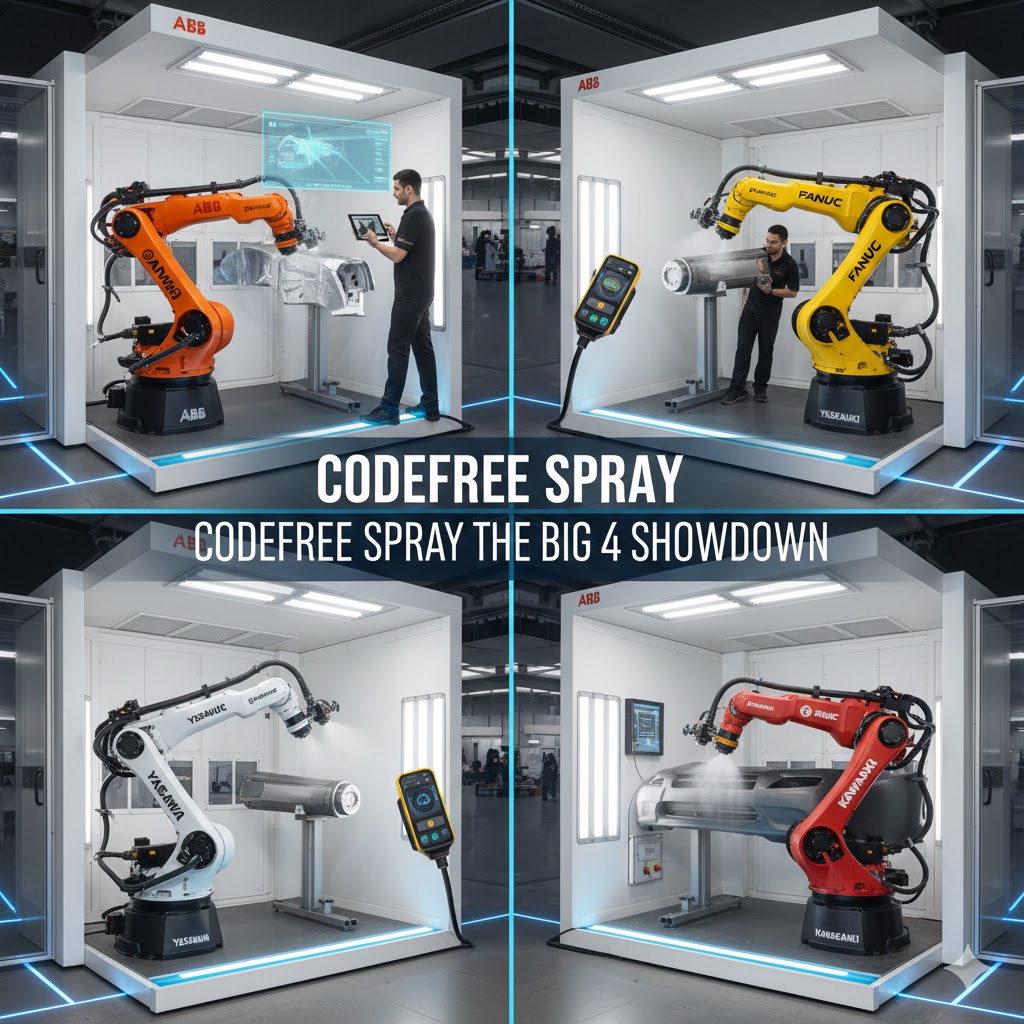
The Big Four's Approaches to CodeFree Spray: A Comparative Analysis
While "CodeFree Spray" might not exist as a distinct product category in every brand's official marketing, all leading robot manufacturers are actively developing and promoting tools designed to simplify programming and deployment, which form the core of CodeFree Spray.
1. ABB: Emphasizing Software Ecosystem and Intelligent Path Generation
ABB's core strength in the CodeFree domain lies in its powerful RobotStudio software ecosystem and its leadership in offline programming and simulation.
Core Strategy: Abstracting programming complexity from actual robot operation through advanced simulation, virtual teaching, and intelligent path generation algorithms.
Key Implementations:
RobotStudio: Users can create 3D models of products on a PC, generate spray paths directly from CAD/CAM data, and perform spray coverage analysis and collision detection without physically operating the robot.
Lead-Through Programming: Operators can manually guide the robot arm to key path points, and the system automatically records and generates the path.
Integrated Spray Process Packages: Provides pre-set spray parameters and logic, simplifying spray gun setup.
Vision-Guided Systems: Combined with vision sensors, robots can automatically identify part positions and shapes, adjusting spray paths accordingly.
Differentiation: ABB's solutions are geared towards high-precision, complex surface, and highly customized spraying, achieving a "what you see is what you get" programming experience through a robust software toolchain.
2. FANUC: Focusing on Ease of Use and Reliability
FANUC's strategy in the CodeFree domain combines its powerful Teach Pendant functionalities with the user-friendliness of collaborative robots (Cobots).
Core Strategy: Offering extremely intuitive and reliable teaching operations, and reducing programming difficulty through integrated, easy-to-understand functional packages.
Key Implementations:
iRPickTool / iRVision: Uses vision systems to quickly identify and locate workpieces, reducing manual effort in setting up spray areas.
Learning Vibration Control (LVC): Optimizes vibration in spray paths to improve coating quality.
CR Series Collaborative Robots: For small-scale, human-robot collaborative spraying applications, CR series robots can quickly set paths via hand guidance, requiring no code.
Spray Painting Package: Provides standardized spray function blocks and interfaces, simplifying spray parameter settings.
Differentiation: FANUC's strength lies in its extreme hardware stability and straightforward user interface. While it might not offer the same depth of offline simulation as ABB, it excels in rapid on-site teaching and reliable operation.
3. YASKAWA: Specializing in Motion Control and Process Optimization
YASKAWA's efforts in the CodeFree Spray domain are primarily reflected in its excellent motion control capabilities and optimization for specific spray processes (e.g., arc welding, surface treatment).
Core Strategy: Simplifying spray setup by optimizing robot trajectory smoothness, response speed, and providing easily integrable process packages.
Key Implementations:
MotoSim VRC: Offline programming and simulation software that supports spray path generation and optimization.
Smart Pendant: Offers a more intuitive graphical user interface to simplify programming instructions.
MotoSense/MotoEye: Vision sensor technology for workpiece recognition and path correction.
Specific Process Instructions: Yaskawa provides optimized instruction sets for spraying, cutting, and other processes within its controllers, reducing the need for users to write code from scratch.
Direct Teach: Operators record paths by directly manipulating the robot's end effector, especially suitable for complex surface spraying.
Differentiation: Yaskawa's forte is precise and smooth motion control, which is crucial for ensuring spray uniformity. Its CodeFree solutions lean towards reducing programming effort through optimized kinematics and user-friendly teach pendants.
4. Kawasaki: Focusing on Explosion Protection and Specialized Spray Solutions
Kawasaki's presence in the CodeFree Spray domain is closely tied to its deep experience in automotive painting and explosion-proof environments.
Core Strategy: Providing highly specialized, integrated spray solutions, and lowering the barrier to spray automation through simplified user interfaces and pre-set programs.
Key Implementations:
K-ROSET: Offline simulation software that allows users to program and verify spray paths in a virtual environment.
Kawasaki Spray Package: Offers an integrated software and hardware solution specifically for spraying applications, including spray gun control and paint flow management.
Optimized Teach Pendant Interface: Kawasaki's teach pendants are optimized for spray applications, offering intuitive options for setting spray parameters, reducing traditional programming complexity.
Lead-Through Teaching Functionality: Allows operators to manually guide the robot arm to record spray trajectories.
Dedicated Explosion-Proof Robots: For harsh, explosion-prone environments, Kawasaki offers industry-leading spray robots, with programming interfaces also optimized for these specialized applications.
Differentiation: Kawasaki's CodeFree Spray solutions are geared towards integrated, professional spray workstations. Its core competence lies in providing proven, efficient, and easy-to-operate solutions for specific industrial spray scenarios, particularly automotive painting.
Conclusion and Outlook
The CodeFree Spray domain represents a significant step forward in industrial automation, making robot technology more accessible. While the Big Four have different focuses, their common goal is to simplify the deployment and operation of spray robots through software optimization, intuitive teaching, vision systems, and integrated process packages.
ABB, with its powerful software ecosystem and offline simulation, is better suited for high-precision, complex, and highly customized spraying.
FANUC, with its extreme reliability and ease of on-site teaching, holds an advantage in rapid deployment and general spraying applications.
YASKAWA, leveraging its superior motion control and specific process optimization, excels in spraying that requires smooth trajectories and high dynamic response.
Kawasaki, drawing on its extensive experience in specialized spraying and explosion-proof environments, provides highly integrated, targeted spray solutions.
In the future, with the advancement of AI, machine learning, and more sophisticated sensor technologies, CodeFree Spray will become even more intelligent and adaptive, with robots potentially adjusting parameters autonomously based on spray results, achieving truly "zero-code" or even "self-adaptive" spraying.